Economics as a Moral Science. American Economic Review: Papers & Proceedings 2011

The annual Papers & Proceedings issue of the American Economic Review is always a good read. It is literally full of papers from leading scholars on the newest “hot” topics in the profession as well as updates on the status of more enduring topics. The format of the issue is ideal for those who want a fairly quick introduction or refresher on a subject, since each is covered by three to four short papers that made up the corresponding session at the recent winter meetings of the American Economic Association. For those who think that economics is a narrow-minded science, it is recommended to pick up the latest issue to experience the variety of matters being analyzed in economics these days.

In these times where the aftermath of the financial crisis is still felt around the globe, many probably have those sentiments about a profession that by and large did not anticipate the crisis. Indeed, lack of the profession’s forecasting success seems very important in the press and general public as well as among the few who had success. I for one, however, have never put much emphasis on forecasting abilities as a measure of success—a solid understanding of the past is much more important, as that can pave the way for good current policy advice in face of unanticipated shocks. Being right about the future in a pure statistical sense is not necessarily a virtue, as you may be clueless about why you were right. Hence, I have more respect for smart people that make unsystematic mistakes than dumb people who get things right every once in a while. Nevertheless, with the benefit of hindsight, the events that led to the crisis are so important and still sufficiently poorly understood that they can, and should, provide lessons that can help the profession gain new important insights about the workings of modern economies.

One collection of papers in the June 2011 Papers & Proceedings is clearly motivated by the profession’s need for self-evaluation triggered by the financial crisis, and it comes under the heading “Economics as a Moral Science”. It deals with various aspects of the potential interactions between economics and other sciences as well as more philosophical considerations to be made in the further progress of economic sciences (inspired mainly by early works going back to Adam Smith). There is an abundance of food for thoughts in the four papers in the collection, and I will mention and comment on a few aspects in the following.

Anthony B. Atkinson writes on “The Restoration of Welfare Economics”, and as the title suggests he criticizes the current state of economics as one that misses out on fundamental issues in welfare economics. By counting recent publications in AER, he finds that very few deal with welfare economics, and that those who do, usually spend little to no time discussing the adopted welfare criterion. He mentions that the profession typically adopts one of three “avoidance strategies”: 1) The economist assumes a representative agent; 2) The economist purports that the profession implicitly agrees on one particular welfare criterion (say, a utilitarian one); 3) The economist leave it to “others” to take a stand on welfare issues. Atkinson argues convincingly that all of those strategies block analyses of central matters like altruism and fairness in the evaluation of different policy scenarios (and he rightfully asks who these “others” may be in regard to the third “strategy”), and are an unproductive way chosen to avoid taking explicit moral standpoints.

Atkinson ends his paper by suggesting that a reinstatement of moral principles into economics could be helped by the introduction of some guideline of good academic practice. He refers to the American Statistical Association who has set out ethical guidelines for their researchers. He believes that a similar ethical code for economists could help reviving the awareness of economics as a “moral science.”

Some of my current and former colleagues have already suggested this, adding more detail, back in 2009 (see Colander et al.; pdf file). I am sympathetic towards the idea as such, since it is born by genuine and profound concerns for the profession. Having weighted the pros and cons, I have nevertheless come to the conclusion that I think it is not an idea that will bring the profession forward. First of all, one has to define a code that all can agree on. This will prove a tremendous task, and I fear that one can only agree on contents that are very general but then at the same time close to empty. Secondly, how should such a code be enforced, and who should do it? At worst people will start just adding “you broke the code” to the usual line of arguments when debating. At best, it can be used in cases of gross scientific misconduct. But for those cases the profession already has systems that work. Anybody caught in misconduct loses credibility overnight and is banned implicitly or explicitly from the profession forever (it is actually one of those situations where the concept of infinite punishments is very relevant). So a formal code adds nothing. This leaves the arguments that I often hear, and which Atkinson also signals: “What can be bad about adopting an ethical code? It cannot hurt”. My counterargument is that it is harmful to do something that ultimately may prove meaningless. In particular, one may add, in a situation where economists are being scolded en masse for having been doing meaningless things. In such times, there is particularly no reason for collectively and purposefully doing a meaningless thing. Academic trust is not obtained by signing potentially empty statements, on the contrary: Trust is gained by actions.

Robert J. and Virginia M. Shiller raise in “Economists as Worldly Philosophers” a number of critiques against the development of economics and economists in recent decades. One of their main points is that too much research has been directed towards too extreme specialization, where many researchers in the process allegedly lost track of the real world. This, as I read them, seems to be their central explanation of why the profession did not foresee the financial crises. Such an explanation, however, suffers all the dangers of extrapolation that history telling may contain: Even if the story is right, does it necessarily mean that a continuation of such behavior will lead to further disasters? The Shillers’ point indeed seems to be that such research should be downplayed in the future. Instead, economists should return to be “Worldly Philosophers” as they were in the Good Old Days, covering all kinds of related disciplines (like psychology—Virginia Shiller is a psychologist). In that glorious past, economists were the likes of Smith, Marx, Keynes, Malthus, who all were deeply concerned about the moral implications of their discipline.

It is difficult to argue against a position which essentially says that everybody should be smarter and act accordingly. Whether it is productive to try to attain this goal by traveling back in time and reduce specialization in basic research is nevertheless questionable. To suggest that contemporary (academic) economists are incapable of taking moral stands, as well as stating that many have a “general knowledge” that may be “embarrassingly limited”, is very strong and borderline arrogant. Atkinson, I believe, is more reasonable by implicitly saying that it is matters that economists avoid speaking up loud about (as they, in my view, perhaps are insecure about the “adequate” morale).

The writing of the Shillers reminds at this point of the elderly who sneers at the youth for being reckless and devoid of reasonable levels of intelligence. In all fairness, they sympathetically do acknowledge this age phenomenon in the paper (“Perhaps there is indeed something about insights gained with aging”, p. 172). Being still in the middle of life, I naturally think that they get too extreme in their dismissal of the output of younger “non-worldly philosophers”. But I take it that when you have developed a renowned business cycle indicator as Robert Shiller has, and used it to be outspoken about the potential dangers of overheating in the US housing market in the pre-crisis economy, then you are entitled to leave the humble self at home and indirectly compare yourself to Keynes. (I talk, of course, about the Case-Shiller index, which ironically is now maintained by Standard & Poor’s—the rating agency which rubber-stamped toxic assets as “AAA” before the financial crisis.)

In short, both Atkinson and the Shillers suggest that economics move forward by doing more relevant research, and by incorporating relevant insights from other disciplines. It is difficult to disagree, but it is equally difficult to see that these are new ideas. Concepts and fields like bounded rationality, animal spirits, experimental economics and psychology have been on the agenda for decades, and fairness, which plays a large part in Robert Shiller’s recent book with George Akerlof, “Animal Spirits”, was a concept developed by Akerlof and Janet Yellen decades ago. It would be more interesting to see new ideas unfold rather than to watch people dream about a return to the days of the past (and their own youth). Such dreams are as extreme as are assertions that specialization went too far. After all, it is often through narrow-minded thinkers that new ideas are developed (think John Nash). Morality and “general knowledge” doesn’t necessarily guarantee wisdom.

Seen in that light, the paper by Benjamin Friedman stands out as far the most interesting piece. He provides a fascinating account of how religious movements in the 17th and 18th century Europe may have influenced the thinkers of the time, in casu Adam Smith. His “Wealth of Nations” from 1779 defines many central themes in modern economics, in particular, that individuals acting out of pure self-interest (and thus potentially without any of the moral sentiments central to Smith’s 1759 book), under the right circumstances can result in a mutually beneficial situation. This “just” requires a little help from the “Invisible Hand”. Friedman sees this thesis as one that was facilitated by religious movements of the times whereby the predominant orthodox Calvinism is gradually phased out. The orthodox Calvinism considered individuals as being utterly depraved and in vicious pursuit of self-interest. Moreover it preached predestination setting aside any role for human choice, and finally, serving God was the only reason for life. Instead, the opposing Protestants would believe in the goodness of man, the ability of human action to play a role for outcomes (and for who will be saved, after all, this is about religion and salvation). Finally, Protestants believed that human happiness was important; not just that of God.

Friedman notices that during these times, various fields were much more intertwined than today. Therefore, these religious debates and movements may very well have had an influence on Smith (even though he was not religious). Moreover, since many of the people shaping the development of the economic sciences were out of religious movements, Friedman argues that the religious movements of the times have had influence not only on economics previously, but also to present day. As he notes, most modern economist avoid models where initial conditions affect final outcomes. This could be consistent with the passing of predestination as a strong religious belief. In the end it demonstrates that economics is a moral science even though many do not appreciate or notice it.

Friedman has several interesting thoughts and I close by quoting from his ending paragraph, which, of course, nicely sums up his points:

Critics sometimes complain that belief in free markets, not just by economists but among ordinary citizens too, is a form of religion. It turns out that there is something to the idea—not in the way the critics mean, but in a deeper, more historically grounded sense (p. 170).

So, pick up the issue and check your own moral sentiments.

Share
Posted in Economic Sciences, Economics, Economists | Tagged , , , , , , , , , , , | Comments Off on Economics as a Moral Science. American Economic Review: Papers & Proceedings 2011

The Real Ariel Rubinstein. Exposed at his 60th birthday

A couple of months ago, one of the world’s leading game theorists (its unclear whether he would like to be called that anymore, but it is what he is generally considered to be), turned 60. To celebrate the occasion, some of his students prepared a “Festschrift” to his honor. This is definitely not a normal piece. On the contrary! It is presented as a collection of “leaked” documents disclosing various moments in the academic life of Rubinstein. It even has a foreword by Julian Assange (or does it?).

Everything is very nonsensical and completely hilarious. It is academic economist humor at the highest level. So I would really encourage you to take a tour into “The Real Ariel” where we, amongst many things, learn that his career got triggered when he looked for dirty magazines as young. The magazine vendor turned out to be a communist, so he gave the young Ariel some old issues of Econometrica, and pointed to the particularly filthy paper by Arrow and Debreu in the 1954 volume.

I can only recommend having fun with this piece. It even “reveals” that Rubinstein has served as an advisor on a dating site. There, his insistence on using exclusively the male pronoun for clarity created some problems when giving advise to a bisexual: “Chose HIM” (this joke is, of course, a kind nod to the open disagreement between Martin Osborne and Rubinstein in the foreword of their “A Course in Game Theory”)

The document is found on Rubinstein’s personal webpage here (pdf file, 90 Kb). Enjoy!

Share
Posted in Economists | Tagged , | Comments Off on The Real Ariel Rubinstein. Exposed at his 60th birthday

John Cochrane on QE2

I have previously mentioned John Cochrane on this blog as a good example of an economist who insists on using sound academic arguments in even the most heated debates. That this does not imply death by boredom, he shows in a recent commentary on quantitative easing at bloomberg.com : “Is QE2 a Savior, Inflator, or a Dud?: Business Class“.

Ben Bernanke said the following about QE2 in March 2011:

“Yields on 5- to 10-year nominal Treasury securities initially declined markedly as markets priced in prospective Fed purchases; these yields subsequently rose, however, as investors became more optimistic about economic growth and as traders scaled back their expectations of future securities purchases”

John Cochrane comments:

“If yields go down, the Fed is successfully stimulating the economy with QE2. And if yields go up? Well, the Fed is successfully stimulating the economy with QE2”

which I think is funny (from a reading experience perspective, not economic), but on a more serious he note he states that

“Moreover, QE2 distracts us from the real microeconomic, tax, and regulatory barriers to growth. Unemployment isn’t high because the maturity structure of U.S. government debt is a bit too long”

The last point is definitely worth thinking about.

Share
Posted in Economists | Tagged , , , | Comments Off on John Cochrane on QE2

Steady as she goes: The ECB keeps policy rate unchanged again

After having raised the key policy interest rate in April (from 1 to 1.25 %), the ECB kept it unchanged on June 9, thus repeating their “non-action” of May. This is a somewhat bold and perhaps unconventional move by a central bank whose overriding legal mandate is price stability. Given their own definition of price stability as meaning an annual Euro-wide HICP-inflation rate not above 2%, you would have thought that the increase in April would have been followed by further increases. After all, HICP-inflation is currently above 2.5%, and unemployment is falling slightly (continuing the downward adjustment, which I have argued earlier could have been the trigger for the April increase in policy rates).

Both factors would under conventional Taylor-rule thinking call for a policy increase, but I suspect that the ECB is being a bit more subtle here. They known that credibility is of essence, and a central bank which manages to anchor inflation expectations need in theory not respond to inflation at all (and the ECB doesn’t appear to have reacted to HICP inflation at all during the past 11 years, as I have discussed previously). In the press conference following the decision of an unchanged rate, Governor Jean-Claude Trichet indeed emphasized that inflation stabilization is of utmost importance:

On balance, risks to the outlook for price stability are on the upside. Accordingly, strong vigilance is warranted. On the basis of our assessment, we will act in a firm and timely manner. We will do all that is needed to prevent recent price developments giving rise to broad-based inflationary pressures. We remain strongly determined to secure a firm anchoring of inflation expectations in the euro area in line with our aim of maintaining inflation rates below, but close to, 2% over the medium term.

He is clearly engaging in signaling here. And this, of course, only succeeds if on has credibility. In that respect, a recent study by Meredith J. Beechy, Benjamin K. Johannsen and Andrew T. Levin is of interest. In their paper “Are Long-Run Inflation expectations Anchored More Firmly in the Euro Area that in the United States?”, American Economic Journal, Macroeconomics 3 (2011), 104-129, they answer (in the briefest possible version of their results) “yes”. So relative to the US, the ECB seems to being doing quite well in terms of anchoring inflation expectations.

But irrespective of this, unemployment is falling (from an absurdly high level), which in itself could be a reason for a rate increase (from an absurdly low level). Here I think the ECB shows, contrary to popular perceptions, that they are not as hawkish as often portrayed in the short run (I mean that as a compliment although it will probably not be taken as such). They mention that the decline in unemployment is not as strong as previously expected (“continued expansion of economic activity in the euro area in the second quarter of this year, albeit at a slower pace“), so they probably do not except much inflationary pressure from that account. And eventually, they keep emphasizing that they picked a wrong inflation measure to focus monetary policy on; namely one that fluctuates with energy prices (which are really not controllable in any sense by the ECB):

The relatively high inflation rates seen over the past few months largely reflect higher energy and commodity prices

I.e., imported, and highly volatile components, which are outside of the ECB’s control.

Share
Posted in Economists, Macroeconomics, Monetary policy | Tagged , , , , , , | Comments Off on Steady as she goes: The ECB keeps policy rate unchanged again

Politics beat quality any day: Diamond calls it quits

Politics are powerful. Much more powerful than scientific arguments. This is probably a well-known dictum, and I am certain that I could find some cool references to great thinkers who have said something like this in the past. I have refrained from doing so, as I just wanted to put this recent example within economics on record:

In the US, members of the board of governors for the Federal Reserve are appointed through a long-winded political process. The fact that elected politicians should have a saying in the nomination of members who will shape monetary policy is sensible from a democratic point of view. I will not dispute that. However, the process often seems to end with a strong focus on partisan criteria rather than the qualifications of the nominated candidates.

This became evident the other day, when Nobel laureate Paul A. Diamond, who was nominated for a place on the board of governors, withdrew from the nomination process as he describes in this New York Times column. Apparently, he could see that he would be blocked by republicans who did not like his support for recent Federal Reserve policies (in particular, quantitative easing). His overall academic qualifications were not disputed directly, but many used the argument that he was not a monetary economist, had no experience from financial markets, and was therefore not qualified. This is incredible hogwash. The man is an exceptionally smart economist, who could contribute productively to any subject area (as he has actually done throughout his career).

But politics are politics. And a Nobel Prize in economics will not change that.

Share
Posted in Economists, Monetary policy | Tagged , , | 1 Comment

“Hi Mom”: Ben Goes Inflation Targeting


I know. This is a VERY late post. I am going to write a few remarks about something that happened 2 1/2 weeks ago. Old news. Nevertheless, big events deserve a comment even after a while. In the April 27 video above, Federal Reserve chairman Ben Bernanke is seen in a press conference following the FOMC’s decision to keep the Fed funds rate unchanged within its 0-0.25% zone. What makes this of significance is that it, as I see it, marks the moment where the United States officially enters the group of inflation-targeting countries.

He explicitly mentions two percent (or a “bit less”) as the average inflation rate consistent with the mandates of the Fed. An announcement of a numerical goal variable is the main defining aspect of any inflation-targeting bank. The particular value was also labeled as “mandate consistent” by Bernanke back in October 2010, so by this confirmation it appears official. Also, by the Fed’s other mandate of securing maximum employment, it is clear that the United States is a flexible inflation targeter. This is evident by the policy decision, where the continued expansive monetary policy reflects that a too high unemployment rate takes precedence over the fact that inflation is currently above two percent (in part due to temporary hikes in energy prices outside of the Fed’s control).

Another key feature of an inflation-targeting central bank is a high degree of transparency and openness about policy deliberations and intentions, which is often aided by press conferences exactly as the one above. The first of its kind in Fed history. So while the Federal Reserve may not label itself an inflation targeting central bank (that could possibly be infeasible for political or legal reasons), it has surely become one, as it fulfills the main criteria laid out in the 1999 book “Inflation targeting: lessons from the international experience” by Ben S. Bernanke, Thomas Laubach, Frederic S. Mishkin and Adam S. Posen (Princeton University Press). By the way, in the first paragraph of the preface of this book it says:

“. . . the United States has lagged behind other industrial countries in considering monetary-policy frameworks and institutions that might help ensure good economic performance in the long term.”

12 years later, it seems that Ben finally managed to make his writing antiquated.

Share
Posted in Economists, Macroeconomics, Monetary policy | Tagged , , , | Comments Off on “Hi Mom”: Ben Goes Inflation Targeting

Can the US Go Bankrupt? Yes, of course it can

A few days ago, the rating agency Standard & Poor’s changed its rating of US government bonds from the usual (highest possible) AAA to a similar one, but with a “negative outlook warning”. This caused havoc around the blogosphere and in policy circles. Some claimed that this was an untimely private, and politically motivated, action serving to undermine public spending programmes in the US. In any case, the market didn’t take much notice, as the interest on government bonds moved little. “Poor Standards” as Paul Krugman called it. He may be right. After all, S&P did funny ratings in the past (remember house-backed securities pre 2007?). And, by the way, it is not the first time, they have raised concerns about the continued AAA quality of US debt. I have no opinion about whether the warning is warranted according to objective criteria, but a government whose debt is around the size of GDP should in most books be worth a check.

What triggered me to write on this is therefore not the rating per se. Instead it is the fact that some has questioned the rating by the argument that the US cannot go bankrupt. For example, James Galbraith is quoted by Dave Lindorff to have said:

“US debt consists of bonds issued in US dollars, which I assume the S&P analysts know. How can the US possibly default on its own currency? The obligation is in nominal dollars, which is to say when the bond retires, the US issues a check in dollars to cover it.  Since the US prints its own currency (or actually just issues electronic payments to create new money) whenever it needs it . . . they will have the money to back their own bonds”

This is not necessarily correct. On every market there is a supply and a demand side. What Galbraith is forgetting is that people may not want to hold the money that the US prints. It has been well known since Cagan’s seminal paper “The Monetary Dynamics of Hyperinflation” from 1956 that there may be limits to how many resources a government can extract through the money press. Technically, financing debts and deficits by money creation is called seigniorage or using the “inflation tax”. And any tax revenue consists of a tax rate multiplied by a tax base. With monetary finance, the tax is the inflation rate, and the tax base is the real money stock held by the private sector (a liability of the government that is eroded in value by inflation; hence, it is “taxed”).

Now consider the thought experiment, as Galbraith does, that deficits and debt are so high that the US must rely on monetary finance to prevent default. By increasing the tax rate on currency (through the printing press), it will indeed for low to moderate rates of inflation be able to generate revenue. However, at higher inflation rates, the nominal interest rate will be higher, and people will want to hold less money (why stick on to something that gives you nothing in return when alternative opportunities get better and better?). In effect, the tax base is being deteriorated. The revenue from printing money at a faster pace may then go down as the increased tax rate (inflation) reduces the tax base (real money holdings in the private sector) sufficiently. Such a “Laffer-curve relationship” in monetary economics is well known, and probably much more well documented throughout history than the more conventional Laffer curve. It means in plain words that there may exist an upper bound on how much revenue a government can extract from money creation.

This is just a too important fact to be overlooked: A country can go bankrupt, even if it has monopoly power over money issuance. Inflation is not just an unpleasant side effect of inflationary financing, it is a phenomenon that may make an attempt to pay back public debt by printing money entirely futile. So yes, the US can go bankrupt. I don’t see it right around the corner, and definitely not because S&P decides to poke a bit to the AAA rating. But don’t think, please don’t think, that the printing press is always a certain, albeit bumpy, road out of fiscal trouble.

Share
Posted in Economists, Macroeconomics | Tagged , , , , , , , , , | 6 Comments

Unemployment goes down and ECB raises policy rate

Today, the ECB raised its policy rate by 0.25 percentage point to 1.25%. This came hardly as a surprise, given the various statements from ECB officials in recent weeks. Many commentators have motivated this by the increasing HICP inflation. However, I would argue that there are other just as applicable, if not better, reasons. Namely that economic activity is picking up, and unemployment is crawling down. Indeed, in the press release following the rate increase, Governor Trichet states

Let me now explain our assessment in greater detail, starting with the economic analysis. Following the 0.3% quarter-on-quarter increase in euro area real GDP in the fourth quarter of 2010, recent statistical releases and survey-based indicators point towards a continued positive underlying momentum of economic activity in the euro area in early 2011. Looking ahead, euro area exports should be supported by the ongoing recovery in the world economy. At the same time, taking into account the relatively high level of business confidence in the euro area, private sector domestic demand should increasingly contribute to economic growth, benefiting from the accommodative monetary policy stance and the measures adopted to improve the functioning of the financial system.

I have previously referred to my empirical analysis of ECB interest rate setting, wherein Morten Aastrup and I find that the ECB predominantly changes the policy rate in response to changes in activity measures like unemployment, but not at all to inflation developments per se.

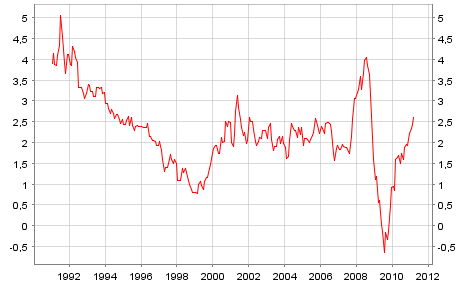
Recent data for inflation and unemployment and HICP inflation does not contradict these findings. Inflation has been allowed to crawl up to 2.6% (0.6% above the official upper bound on a desirable inflation rate), while we now see a decrease in unemployment. Had the ECB followed more Taylor-type rule behavior they would have raised rates much earlier. But it seems to follow a credible anti-inflationary policy, under which one does not have to respond to actual inflation.

Unemployment data from ECB.int:

Unemployment rate in the Euro areaHICP inflation data from ECB.int:

HICP inflation in Euro area

Share
Posted in Economics, Monetary policy, Uncategorized | Tagged , , | Comments Off on Unemployment goes down and ECB raises policy rate